Thursday, 10 February 2022

The Worst Person in the World | Norwegian | Movie Review

 10th of February 2022. Watched. 


 My rating: 9/10.  

 I was reading in the sun, all nice and warm when suddenly a bout of melancholia hit me in the face. To cure it, I came back downstairs, set all the windows, spread all the drapes and decided to watch The Worst Person in the World because I had my eye on it for a long time. But, instead of suppressing my mood, it made it flourish into this lovely bouquet of sadness and roses. My heart was about to be ripped out of my chest by the time I was done with it.


My ears are still burning and my eyes are still full of concealed tears. And I love this film for it.

The film began with the side shot of a protagonist having a smoke and looking as if she needs to be somewhere else, following with the text on a black background declaring it was a 'A film in 12 chapters, a prologue and an epilogue.'. Now, I was reading Satyajit Ray's piece that he had written about his fascination with the French contemporary director, Jean-Luc Godard, right before I watched this film. So naturally it reminded me of how Godard's 1962 film Vivre Sa Vie: film en douze tableaux (Living your Life: film in twelve scenes).

I believe I watched Vivre Sa Vie in the December of 2020 and I remember appreciating it but not liking it much. And now after watching this 2021 Norwegian film, I can't help but say that it feels like a 21st century remake of the 1962 French film. Both are character studies. Both are a character study of a young woman in a big city. And both break conventions of the genre by the use of non-traditional forms of camera movement to communicate the connections and disconnections of the protagonist from the people around her, thus contributing to the cinematic language in it's own unique way.

The other film which it reminds me of in it's tone and narrative structure which spans years is Blue is the Warmest Colour (2013), the erotic epic of 3 hours about 2 women. Both TWPITW and BITWC are about an existential movement in search of self. Both the films follow the protagonist when they're young students and follow their journey towards adulthood and self actualization. As it turns out, 30 is the new 20 in our ethos of the 20s' (2020s'). At least that's what these coming of age films set around characters in their 20s and early 30s seem to be pointing towards anyway.

The film uses many tricks not only visually in it's imaginative blocking, but also in its soundtrack as well. The many well thought out inclusions of popular songs as diegetic and non-diegetic that would've resulted in a severe distraction in the hands of a lesser filmmaker, instead provides for an utterly moving aural experience.

But the soundtrack can only make for a vibrant backdrop for the actors' performances if they are on par with the rest of the production. And its such a delight to say that not a single character felt miscast. Especially Renate Reinsve as the leading lady. If it had been the case, the film would've simply sunk like a dead rock. Like most people, I had never heard of her before this film and like most people the first thought that I had upon looking at her as Julie in this film was that she was the spitting image of Dakota Johnson. The bangs, the slimness, the dress she wore in the opening shot... everything came together to shout Dakota Johnson. Oh please, if there is goodness in this world, don't make an American remake of this film with Dakota as some lost souls are trying to remake the Danish film, Another Round (2020).

There are a couple of people in my life who are in their early 20s (and 19) who will love this film. The sad reality is that they'll never watch it because its either not in English or Hindi or because I asked them to watch it. I've stopped recommending people movies unless they specifically ask me to. And I think that's working out pretty well for me, even though I would've liked my circle to be a bit more into my likings. But don't we all want that!

Monday, 31 January 2022

Westworld | Season 1 | Review

31/Jan/2021

 Season 1. Watched. My rating:  8.9/10. Every once in a while there comes a show, a movie, a book or an album which has a premise one would describe it as "difficult to describe". An elevator pitch of this show would be Jurassic Park (1993) meets I. Robot (2004). 

 Set in a distant future which is ever so looming, Westworld is an amusement park in the theme of the wild west; like Red Dead Redemtion, only real. The park's residents include a number of androids whose minds work with such baroque intricacies that they are practically indistinguishable from humans. Perhaps 'mind' isn't the best word; CPUs would make for a better fit. But what is a mind after all, if not a central processing unit? That's the central question the show ponders at. 

 The 1973 film that this series is adapted from, is written and directed by none other than Michael Chrichton himself. The author of Jurassic Park, The Terminal Man and other classics of the genre. A huge name in the science fiction community, his work is bound to be adapted for generations to come. And I'm bound to compare Westworld to Jurassic Park for their rather similar premises. In both the stories, the humans are so focused on whether they can do something, they never stop to ask if they should do something. Preoccupied with accomplishments; dinosaurs in JP and robots in Westworld. 

 But, in both cases, the lack of conscience on our part, i.e the humans, bites us back. The dinosaurs break through their cages of steel and wire and the robots break through their cages of codes and scripts. In other words, the androids gain consciousness. 

 But is it consciousness, though? Or just another set of algorithms falling like dominoes one after the other, creating a mosaic of self awareness. An illusion. 

 But aren't we, in a way, are a collection of dominoes as well? Destined to fall, fated to perform like the many others before us? As I try to navigate this maze of a philosophical query of mine, I keep coming back to this question: What is mind, if not a highly complex computer designed to solve problems of mortality?

 Like JP, the story also features a wealthy, old man- a man of science- who created this park. Played by Anthony Hopkins to perfection, the Shakespear qouting Dr. Robert Ford is a morally grey character who keeps you intrigued even when he is not on screen. Anthony Hopkins is the man single handedly responsible for my obsession with serial killers because of his Lecter. And obviously he is among my favorite thespians to ever have walked this Earth of ours.

 When it comes to cast, almost everyone delivered what the script demanded of them. Acting and actors are perhaps the least interesting aspect of filmmaking for me. What can you really say about them? Either they were good or bad. Yes, I could inject infuriatingly poetic lines which account for how their performances moved me. But of what use would that be for anybody, least of all me. My ignorance stems from my lack of knowledge about acting as a skill, and I intend to correct that. Although I'm not sure when.

 I just want to add that Evan Rachel Wood's Dolores Abernathy had my heart from the first frame and it just goes to show how well she was cast as the leading android. She not only lifts the heavy emotional crescendos, but also provides with an unsettling neutrality when her character demands it during the sequences of analysis. 

  I had no idea that Ed Harris from Apollo 13 (1995) and The Truman Show (1998) would show up in this and I'm so grateful for his inclusion. He is among the finest actors and we don't talk about him enough. Each and every line of dialogue from his throat blooms as a gritty melody of it's own.

 The music and sound effects are fantastic in this film. Not a single mechanical whirr or a transitional whoosh feels out of place. Can't believe I wrote the last sentence with a straight face but I did. 

 I binge watched the last four episodes of this season and it just kept getting better. The story unfolds against two seperate back drops: one is the period piece of a park and the other is the futuristic office of the park, where the developers mend and develop robots and internal politics of the company takes place.

 This first season was among the best written science fiction stories that I've seen and I hope it only gets better. Alas, all that I've heard so far is that the following seasons only degrade in quality. I hope at least I like them. Or like them enough to have a satisfying conclusion.

Friday, 31 December 2021

Aparajito (1956) | Review

30/Dec/2021.

Last film of the year.

Watched. 

My rating: 10/10

 This being my second Satyajit Ray film, I can most definitively confirm that Ray is a cinematic god and he truly deserves his place among names like Bergman, Fellini and Truffaut. 

  This film invented the bounce lighting technique. And now I know where Karan Johar got the scene of a man feeding seeds to birds whilst saying, "Aao. Aao. Aao..." (Come. Come. Come...). The same sciene is used in Johar's 1995 film, DDLJ and that's the film because of which the scene is in the mainstream consciousness of the Indian audience.

 I'm once again writing against my writer's block today and I'm anxious as hell. I should've written it last night, it would've been one of the better pieces of this month.

 The film picks up where the first film left off, and things are starting to look better for the Roy family. But soon, tragedy strikes again and Apu and his mother are left to fend for themselves. They move back to the village and try to live a happy life. Apu does well in school, grows up and moves to Culcutta, leaving his woeful mother behind and only seldom getting a chance to visit her.

 The film is all about how something flourishes for a fleeting moment. Like a lonesome daffodil in spring, moments bloom and await us. It us our lack of understanding of their fragility that leads us to unhappiness. Our very own mortal uncertainty is the cause for our happiness and our sorrow. And Appu learns this lesson by the end of this film, but then its too late. 

 Satyajit Ray's films capture the very soul of Indian literature. The literature on which I grew up on and have loved dearly. His echo with the likes of stories found in the Nandan and Champak magazines or R K Narayan's Malgudi Days. There is a certain earnestness about them which resonates very strongly with me. And the score of this film carries that same energy with it.

 This film, like Pather Panchali, boasts of a score by Ravi Shanker. I recognize him as the man who taught George Harrison of the Beatles the Indian musical theory. But man... I've become a fan of his music. And he reminds me of Illaiyaraja because of his mastery over classical music. His score conveys the doleful fate of a mother and a child's joy and wonder. It conveys the anxiety and it conveys the hope for the future. The music elevates the film in scented coils of purples and yellows and blues and pulls us into Apu's sansaar (world). 

 There are a few swift pan cuts in this which are just mind blowing. The editing overall is revelatory and so are the actors. Karuna Bannerjee, who plays the mother, is a spectacle to behold in this. Her each gesture embodies care and resiliency. At times I had to remind myself that its a performance and I'm watching a movie. I wanted to step into the screen and give her a big warm hug. The two actors which played Apu and Kanu Bannerjee, who played Apu's father, were equally great as well but Karuna was the highlight of this film for me.

 This film made me smile, laugh, and cry. Oh did this film made me cry... This is what cinema is for. For telling your own truth. For being honest. For putting the human condition up on display in all it's terrible beauty. An empathy generating machine indeed. 

 I bow before you in awe and gratefulness.

Sunday, 31 October 2021

Dune 2021 | Review | IMAX

  Review written on 31/Oct/21.

 Watched in IMAX on 23/Oct/21. 

My rating: 9.5/10


 I read Frank Herbert's iconic sci/fi epic, Dune in January of 2021 and I must say that it was an experience. An experience of being on an alien planet. An experience of a strange but seemingly familiar culture. An experience of alien weapons, vehicles and other wonders of technology.

 And whilst reading it, I found out that a new big screen adaptation is coming out and it is directed by none other than Denis Villenueve, the man behind Arrival (2016) and Prisoners (2013). Arrival is perhaps among my top 3 sci/fi films of all time and is my favorite first-contact film. It is exactly what I want a first-contact film to be; a film about linguistics. And as a big fan of language and it's workings, I think Arrival really hits the spot for me on multiple levels.    

  Like in the book itself, Arrakis -the Dune planet- is the main character of the film. The priority here was to build a world rich enough, diversified enough, to be passed off as a living and breathing eco system. And Denis and his team surpassed all of my expectations when it came to it. They've conjured up a world comprised of real and CGI landscapes of vast magnitudes. The grassy cliffs of Atreides' home world, Caladan look just as good as the endless swells of the deserts of Arrakis. Not to mention the breathtaking, 2001: A Space Odyssey-esque shots of ships hovering near planets. The warmth of the colours leapt from the screen and the cold pallets drew us in. The experience of watching it in IMAX was surreal and for a film like this, accept no substitutes.

 From the mammoth sandworms themselves, to the desert dwelling muad'dib (kangaroo mouse), the fauna and flora really sells it as a world that could actually exist. There's a shot in which a Muad'Dib scurries along the top of a dune, stops... and we see veins visible with the sun coming through it's thin flesh, droplets of sweat slowly dripping down towards it's mouth. And then it carries on. Little moments like this is what makes this film stand away from the crowd of blockbuster movies with an identity of it's own. And, if you don't know the story, that little mouse might play a huge role in the sequel. I'm not spoiling anything. Just giving you a taste of what's to come.

 But, like any film with visuals like this, the question arises: does the sound design match the scale of what's being shown? The answer is yes. I had begun to grow weary of Hans Zimmer's music. But, the first thing that I said to my friend during the intermission was that Dune revived my fondness for Zimmer. The feminine chants in the score plays with the Sufi mysticism of the Bene Gesserit and adds to the ancient wisdom of the desert and the Fremen and the bagpipes are regal in every sense of the word, reminding me of Dead Poets Society's theme. The sound design overall is fantastic, with each little effect adding so much depth to the atmosphere. There is one scene in particular where Paul gives a gun back to a character, unloading it beforehand. The click-clack of the weapon... for some reason, its just perfect.

 When it comes to the story, I've already said my two cents about it. I could further relate the subtext of Arrakis as Iraq, spice to oil, fiefdom, anti-imperialism and so on and so forth. But there's no point to it because it all has been said before and said better by people who understand the politics of our and the Dune's world much better than I do. I compared Dune's story to Lawrence of Arabia's (1962) in my review for LOA and I think all of which that I said in it still applies to this film. Instead, I'd now like to talk about the cast.


 The casting in this film is pitch perfect. Every character feels right as rain. The somber mood is rather difficult to pull off, especially in a big budget blockbuster such as this. But each and every single character nails their performance to the floor and its difficult to imagine someone else play them. The only actor which I thought didn't really fit the character was Stephen M Henderson as Thufir Hawat. Thufir Hawat is one of the most interesting and important characters of the book but he doesn't get enough time in the movie to develop. My dream-casting for Thufir would definitely be Robert Duvall. That would've been something. While we're at it, I must also say that if they include Count Fenring in the sequel, it should be played by Jeff Goldblum.

 Timothee Chalamet is perfect as the young Paul Atreides. The hearth-robe proves time and again that he is more than just his looks and Dune is not an exception. I loved him in Call Me By Your Name (2017) and every film that I see of his, he becomes a more and more exciting actor. Rebecca Ferguson who plays his mom, Lady Jessica also steps up her game and you really feel her protectiveness and strength in each scene.

 I was a bit doubtful with Oscar Isaac playing Duke Leto, but I'm more than happy to announce that he ruled each scene with eye and claw with his hawk like features. Commanding, to say the least.  Jason Momoa surprised me with his very likable Duncan Idaho. And Josh Brolin's voice just made me scream "Thanos!". But it went away quickly because no character, except for Paul and Lady Jessica gets much screen time for the sake of world building. Which is completely fine with me.

 Now, lets talk about the literal big bad guy of Dune, Baron Vladimir Harkonnen. Played by Stellan Skarsgard, Baron comes off as very similar to Brando's Colonel Kurtz with his big belly and calm demeanor. As you know, Apocalypse Now (1979) was my number 1 film of 2020's top 20 list, so it makes me very happy to see that they chose to go this route with Baron. Stellan floats around in his suspenders and eats up every scene that he is in. I just hope we get to see more of his intimidating presence in the sequel.
 

 The costume and set design is splendid as well. The stillsuits couldn't have looked better with their medieval patterns and fittings, it screams that its designed for agility and survival. I personal favorite costumes are that of Lady Jessica, especially when she first arrives on Arrakis, adorned with jewellery  from head to toe. The academy must get this film nominated at least for visual effects, costumes and set design.

 Dune is a perfect adaptation. It couldn't have been any better. If you've read the book, there are a lot more references that you will enjoy. And I do think that its a film primarily made for the fans of the book. The only reason that I cannot give this film a perfect score is because it's story is incomplete. I love the fact that it ends in an ellipsis, but I must admit that it leaves much more to be desired, which is it's intention. The two and half hours feel like an hour and just as the story gets going, it ends. Its a perfect prologue. A perfect introduction. And I do hope that the sequel builds on it tremendously.

 Dune is what I wanted from Marvel movies. A big budget meditative spectacle. My first experience of IMAX couldn't have been any better. I'm glad that this is the first adaptation of dune that I decided to watch.

 I wish Frank Herbert would've lived to see this...


Wednesday, 13 October 2021

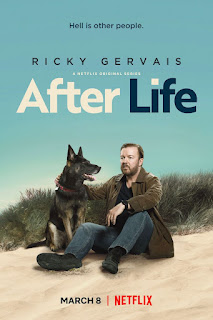
After Life | Seasons 1 and 2 Review

Seasons one and two. 4 Oct 21 - 6 Oct 21.

My rating: 6.9/10. 


 Here we are again. I'll tell you how I've lost my will to write. About all the trappings of being an unmotivated writer. About how I fear that I don't have anything new to say. And then we'll both go on our merry ways.

 After Life, believe it or not, is the third comedy that I've tried watching which turned out to be about depression. First being Fleabag and the second World's Greatest Dad (2009). It strikes a chord within me, this theme. A chord which has been struck more often now than it ever has before. But let's not go there. Now's not the time. 

 Written and directed by Ricky Gervais, it finds Ricky as the lead, a bloke called Tony who lost his wife six months ago and is still in grief. He is angry at the world because everyone is alive but not his wife. He is suicidal, as well. The only reason that he doesn't kill himself is the bitch- a female dog- that he has. A friendly German Shepherd, if you're interested.

 But its not all moanin' and whingin' with Tony. He fancies his father's nurse in the old age home and she fancies him back. But he can't bring himself to be with her because he feels like he is being unfaithful to his wife. To his dead wife, to be clear. He also takes a liking to a young girl who just started working at the Tambury Gazette, Tony's workplace where his boss is his brother-in-law. A walking-talking reminder of his wife who keeps trying to cheer him up even though he has problems of his own with his marriage.

  I quite liked the little world that Ricky managed to create here. With little characters that he keeps bumping into, it feels like a Sunday morning cartoon show which is not meant for kids. Its more of a drama then a comedy. Its talks about some dark subject matter but its not entirely cynical either. The show maintains a glint of optimism as it talks to you, which is nice. 

 I enjoy Ricky Gervais very much. I believe I've watched all of his stand up specials. A lot of his interviews and, of course, The Office (and An Idiot Abroad very recently). But I do think that After Life is summation of his ideas. Repetitive ramblings of an aging comic, that is. And some scenes do feel a bit forced to fit his same-old-same-old one liners into the show. I like those one liners, but I do think they've gotten stale. 

 The direction by the man himself is nothing to hold the ship for. I mean it's fine, serviceable. Some needle drops were pretty good but the background score was overused. 

 Like all melodramas, you've to be in a particular state of mind to connect with the story. I couldn't recommend it to anyone, but if you're anyone, just watch the trailer and you'll know if you wanna watch it or not. I'd love to watch its third and hopefully final season. Yeah.

Wednesday, 8 September 2021

Fleabag | Complete Series Review

Seasons 1 and 2. 4th and 5th of September, 2021.
Watched. 
My rating: 10/10
 
I picked up Fleabag because I thought it was just a light comedy with a couple of seasons of short episodes. But I was so wrong... and I'm glad for it.

 Fleabag follows a 30 year old woman who remains unnamed for the entirety of the narrative; but you may adress her as 'Fleabag' because of obvious reasons. She struggles with depression after losing her best friend to an accident, has to revive a dying cafe and try not to screw her relationship with her family any more than she already has. She masks self hatred with her razor sharp sense of humor whilst constantly breaking the fourth wall to offer her insights of her world in an intimate manner to us.

 Phoebe Waller Bridge, who wrote and starred in Fleabag, has achieved something here that not many writers are capable of; writing a story which interweaves two seemingly opposed genres together so seamlessly that it becomes rather difficult to notice when one shifts into another. The two genres that I'm talking about are, of course, comedy and drama.

 Now, I'm not saying that two have never met before. In most dramas, you'll find a hint of comedy and most comedies will find their roots in some sort of dramatic foundation. What I'm saying is that I've seldom seen it done so well, so pitch perfectly, as it is done in this show. The show blends the funny and sad bits of life so well that sometimes it left me unsure weather I should laugh or cry. 

 Not a single scene overstays it's welcome and tells more about the character than you'd expect in such a short span of time, maintaining the break neck speed. Every character is passive aggressive in this but none more than Olivia Coleman's character, Fleabag's Godmother. I just watched Olivia in The Father (2020) and I genuinely felt sorry for her character. But in this, I just wanted to smack her in the teeth. It just goes to show how good she is. Unbelievably good!  

 When it comes down to it, everyone in the cast is really at the top of their game in this one. Weather it be Sian Clifford as Flebag's sister, or Bill Paterson as Fleabag's dad or even Brett Gelman as the Fleabag's perverted douchebag of a brother in law, every single person draws out the emotion the scene demands and makes it look as easy as a walk in the park. And, of course, witnessing Andrew Scott- Moriarty from BBC's Sherlock- as the "Hot Priest" is delight of it's own.

 The melancholic overtone of the show really struck a chord with me, making it the first 10/10 piece of art that I've watched in months. I'm not sure if it will connect with you, dear reader, as much as it did with me, but I'd urge you to check it out nonetheless. 

Fleabag's seldom poignant, often humorous portrayal of grief is as sincere as one can expect, and I'll most definitely return to it in future.


Monday, 2 August 2021

Loki (2021) | Review (not really)

1/Aug/2021. Watched. 

My rating: 5.8/10.


I do not have it in me to write anymore. And I don't wish to write something which doesn't come from the heart. Have I lost my passion?

Humans in the Loop | 2025 | Film Review

 (I haven't written a piece on a film in almost two years, so let me stretch my wings...) On the 23rd of February, a friend took me ...